What Custom Drapery Costs in Pittsboro and Why It Varies
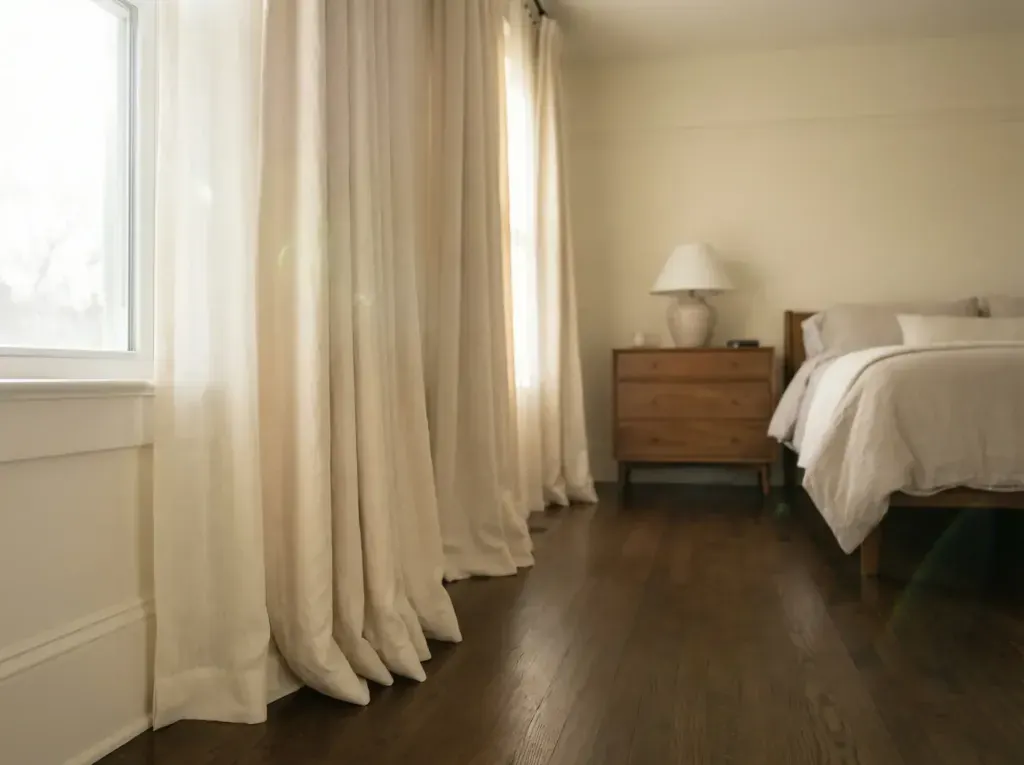
Every part of a drapery order gets fixed the moment the fabric is cut, which is exactly why the measure matters more here than on any other product we install. Fullness, lining, hardware and the finished length all interact with each other, and getting one wrong throws off the rest even when the sewing is flawless. Here is what a workroom needs settled before a Pittsboro order goes to the cutting table.
Pleat Styles and Fullness
Every custom drapery order starts with a pleat decision, because it shapes everything else about how the panel behaves. Pinch pleat is built around a stiff buckram header and tacked by hand, the tailored choice that holds its shape for years on rings or a traverse track. A two finger version uses less fabric and drapes a bit softer, suited to a more relaxed Pittsboro family room. Goblet pleat holds a rounded, stuffed shape that only really works on a panel that stays put, since daily drawing wears the shape out fast. Ripplefold and grommet both skip traditional pleats: ripplefold rides a dedicated track for an even wave that stacks tight, while grommet rings ride straight on a rod sized to match.
Fullness ratio is the flat fabric width divided by the width the panel actually covers once hung. Two times fullness on a 50 inch span means roughly 100 inches of fabric before hems and returns. Pleated drapery typically runs 2 to 2.5 times fullness, and dropping below that makes the pleats look pinched. Ripplefold gets specified as a percentage instead, most often 80 or 100 percent.
Hardware, Stack Back and Floor Break
Stack back, the chunk of wall a fully open panel takes up, climbs with fullness, fabric weight, lining and pleat style, and it explains why so many drapery panels sit on top of the glass instead of beside it all day. Mounting the rod wider than the window and higher than the trim gives the panels wall to stack onto instead. A one way draw, pulling entirely to whichever side has room, is the answer when the wall runs out on one side.
A return carries the panel back to the wall at the end of the rod, and without one, a thin line of light runs down that outside edge. An overlap lets the two panels cross in the center so closing them does not leave a gap. The bracket has to bite into real framing or a rated anchor, and a rod running any real distance needs a center support. Float, roughly half an inch up, holds up daily use and pets. Kiss just grazes the floor, elegant when level and unforgiving when not. Break folds softly with an extra inch or two of length. Puddle piles three inches or more and only makes sense on a stationary panel. Take the floor measurement at several points, since plenty of Pittsboro homes have a floor that shifts.
Lining Choices and Fabric Behavior
Unlined drapery is soft and lets real light through, but the face fabric fades faster with nothing between it and the sun. Standard lining, a sateen backing, gives the panel body and reduces and slows fading on the face fabric, though it never stops it outright.
Blackout lining stops light through the cloth itself, but light still slips around the panel unless overlap and returns are generous, and needle holes at the tacks can show as small points of light. Interlining adds a soft flannel layer between face and lining. It is the most expensive option, adding weight for a deeper fold and softening sound a little in a hard room. Linen moves with humidity, so a panel that brushed the floor in a damp month can drag in a dry one, which is why it usually gets floated rather than kissed. Velvet needs real hardware behind it, and sheers need more fullness than anything else to avoid looking thin.
Choosing Drapery Room by Room
A shade controls light. Drapery finishes a room, taking the edge off hard surfaces and giving a window somewhere to belong instead of sitting there like a hole in the wall.
- Living rooms get the biggest payoff from drapery, mounted high and wide, often left stationary while a shade underneath does the real work.
- Dining rooms can lean formal, since they get used mostly after dark anyway and closed panels read as intentional rather than in the way.
- Primary bedrooms need drapery to actually work: a blackout lined panel over a room darkening shade, with real overlap and full returns, is what makes the room dark.
- Kids rooms do best kept simple, with stationary panels next to a cordless shade built to ANSI/WCMA A100.1-2022, so nothing is left hanging loose.
- Home offices calm down with stationary panels beside a solar shade, cutting glare and taking some of the echo out of a room full of hard surfaces.
Around Pittsboro and Jefferson Park, the drapery that looks effortless almost always comes down to the same sequence: the rod went up first, wide and high, and the fabric got picked to fit that plan rather than the other way around.
A good drapery panel is mostly decided before the fabric ever gets cut: the pleat, the fullness, the lining, and the length that actually reaches your floor. Pittsboro Window Treatments treats the measure as the real work and the sewing as the part that follows it. Call (317) 999-5154, and we'll come measure your Pittsboro windows in person.
What Custom Drapery Costs
Yardage, not fabric alone, drives most of a drapery quote. The formula: width covered times fullness, plus returns, overlaps and hems, divided by usable fabric width, gives the number of cuts, and that times finished length gives total yardage. A pattern repeat adds further cost, since every cut must align the pattern, and a large repeat on a tall window increases waste significantly.
Nationally, custom drapery measured and installed runs roughly $250 to $2,600 a window, typically toward the higher end given yardage and labor demands. Hand tacked pleats, interlining and mitered hems all add sewing time, which is also why well built panels still hang correctly after years of use. Hardware is commonly quoted separately, so confirm inclusion before comparing a Pittsboro quote to another. Costs that surface later include dye lot mismatches on panels added after the original order and cleaning limited to dry cleaning or an in place service. When comparing quotes, request the same information from each company: fullness ratio, pleat style, lining type, hardware inclusion, and lead time.
Frequently Asked Questions
Can drapery hang over blinds or shades I already have?
Yes, and that's how most drapery actually gets installed. The one thing to check is projection. Measure how far the existing headrail, cassette or fascia sticks out from the wall, then pick a bracket with enough reach that the panel never rubs it. A standard bracket often will not clear a deep fascia. Mount the rod higher and wider than the shade so the stack sits off the glass, and if the shade is motorized, keep the battery access reachable.
Does blackout lining make a room completely dark?
Not by itself. Blackout lining stops light through the cloth, but light still comes around the panel at the sides and over the top unless you have generous overlap in the middle and returns that carry the fabric back to the wall. Needle holes at the tacks can also show as small points of light on a bright window. The dependable setup is a blackout lined panel closed over a room darkening or blackout shade, which covers the edges the panel alone cannot.
What is interlining and is it worth paying for?
Interlining is a soft flannel layer sewn between the face fabric and the lining. It adds weight so the panel falls into deeper, more even folds, and it takes some of the edge off sound in a hard room. It's the most expensive lining choice, and it's also the one that makes an ordinary fabric look expensive. In a formal dining room or a primary bedroom, it earns its cost. In a casual den, standard lining is plenty.
 Custom vs Stock Blinds in Pittsboro: What Actually Differs
 Cordless Blinds and Child Safety in Pittsboro Homes