Faux Wood Blinds

Faux Wood Blinds in Pittsboro, IN

Composite slats for the wet rooms of a 2004 town

Call (317) 999-5154Get Free Quote
Quick Answer

A short orientation before the detail: this product gets measured in your home, built to those sizes, and installed once it arrives. The answers here cover selection, operation, care and what the warranty does and doesn't include.

  • Service: Faux Wood Blinds for Pittsboro homeowners
  • Service area: Pittsboro, IN and surrounding areas
  • Two different timelines apply. New custom product takes weeks because it has to be made. Repairs to what's already hanging, a cord lock, a ladder string, a chain that jumped the clutch, are usually far quicker.
  • Insured and bonded
  • Serving Pittsboro, IN since 2008
Faux Wood Blinds Services

Expert Faux Wood Blinds for Pittsboro Homes

Pittsboro's 393 houses from the 1990s are where faux wood earns its keep. That decade is the entire 1980 to 1999 block in this town, because the ACS records zero units built between 1980 and 1989, and a 1990s two story production house here runs 16 to 24 openings finished with drywall returns and no applied casing. Faux wood sits in that clean reveal without a fight. Jefferson Park is described as an established residential area with modern layouts, which in a town whose median build year is 2004 means roughly twenty years old rather than fifty. Wet rooms get it first, and in Pittsboro those rooms are newer than most owners assume.

The honest cost of faux wood is weight. A PVC or composite slat outweighs basswood, so a headrail much past 72 inches wants a center support bracket or a two on one split, and that split reads as a vertical seam down the middle of the glass. Hidden Hills Exclusives plans in the $413,000 to $466,000 band carry 20 to 28 openings, and the wide ones are where that call gets made. Faux wood also softens under sustained heat. A slat behind unshaded west glass on an open former farm lot can take a slow bow over three or four summers, and no warranty covers a slat that gradually curved.

When to Call

Signs You Need Faux Wood Blinds

If you notice any of these in your Pittsboro home, it is worth booking a measure. None of it is urgent, and none of it fixes itself either.

Kids rooms still have looped cords from the previous owner

Cheap plastic blinds have yellowed since the day you moved

Condensation runs down the glass onto the sill each January

You want the look of wood in a wet room

The valance is missing and the headrail shows from the couch

You want one color of blind through the whole house

A wide headrail settles in the middle when lowered

Tilting the slats takes two hands and real patience

You are buying blinds for a house you plan to sell

A rental turnover needs blinds that survive tenants

Our Process

How Pittsboro Window Treatments Handles Faux Wood Blinds

Every job follows the same five-step process. Transparent, thorough, and done right the first time.

1

In-home measure booked

2

Room moisture read first

3

Mounting depth taken

4

Valance style picked with returns

5

Color held against your trim

Real Project Photos

Faux Wood Blinds in Pittsboro

Photographs from real faux wood blinds jobs completed by our crew in Pittsboro and surrounding areas.
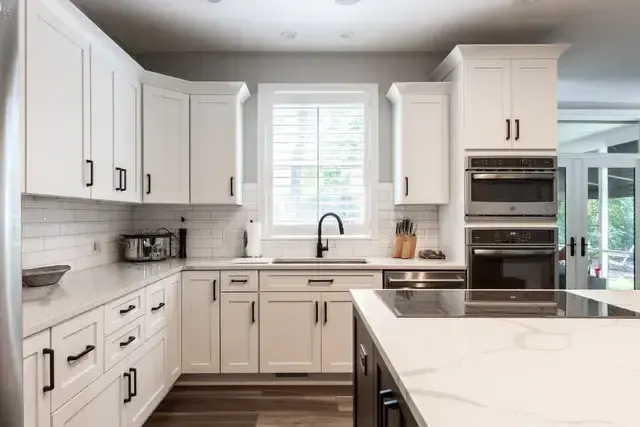
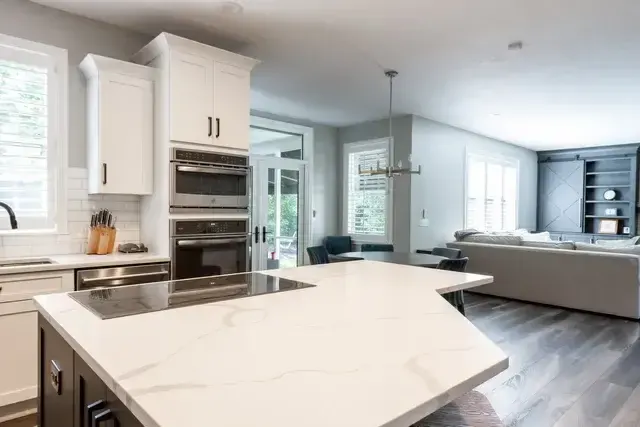
Custom shades measured and installed in PittsboroPlantation shutters fitted to a Pittsboro windowCellular shades in a Pittsboro living room
Scope of Work

What Faux Wood Blinds Includes

Every Pittsboro job is documented item by item. Here is what the crew covers.

Every opening measured three widths and three heights, then checked corner to corner for square

Room moisture read before the material call, so baths, kitchens, laundry rooms and finished basements get faux wood

Mounting depth taken at the top of the opening so a 2 inch headrail clears the trim and any hardware

Solid PVC and wood-polymer composite separated on the order, because they don't weigh the same or behave the same

West and south openings flagged, since surface heat on a dark slat is what starts a bow

Slat size set per opening, 2 inch as the standard and 2 1/2 inch where the window is wide enough to carry it

Center support bracket planned on any span wide enough to let a loaded headrail settle in the middle

Wide openings split two-on-one so no single blind carries more weight than its brackets should

Finished weight checked against the opening before a wide unit gets ordered as one piece

Routeless slats specified where a row of lit route holes would be noticed from inside the room

Cloth tape ladders offered where the route holes should disappear behind a band of fabric

Tilt wand set as the default, with cord tilt only where a wand can't clear a handle or a return

Cordless lift specified in rooms that kids and pets actually use

Products specified to conform to ANSI/WCMA A100.1-2022 for cord access

Valance style and return depth chosen so an outside mount really closes off the sides

Factory deduction left with the manufacturer so the allowance never gets taken twice

Light gap per side written onto the paperwork before the order goes to the factory

Old blinds pulled, brackets removed, and every new unit tilted and lifted end to end before we leave

Pricing

What Faux Wood Blinds Cost in Pittsboro

National category figures put stock blinds and shades near $60 to $600 a window, with custom-fabricated units running roughly $250 to $2,600. Those are published national ranges for the category, not a quote for any address in Pittsboro. Faux wood lands low in that band, which is most of why people choose it. A 2 inch composite blind on an ordinary bathroom opening is inexpensive work. Price climbs when the opening gets wide, because weight is the real constraint here: a wide span wants a center support bracket or a two-on-one headrail, and both add parts and install time. Routeless slats, cloth tapes and a cordless lift each move the number as well. Pittsboro Window Treatments prices from measured openings around Hendricks County, never from a per-window average.

By Product

How Faux Wood Blinds Differ by Product

Every product in this trade behaves differently in a room. Here is what that means for this work.

2 inch faux wood slat: The size most houses around here want, and the one we start from. It gives you a real view between open slats without the stack a wider slat builds at the top, and it stays flat across an ordinary bath or bedroom opening.

2 1/2 inch faux wood slat: Fewer slats over the same height, so the face reads cleaner and the open view improves. It also weighs more per running foot, which is exactly why we settle the span and the bracket plan before writing it onto a wide window.

Solid PVC slats: The least expensive construction we hang and the most waterproof. It's also the heaviest, and it's the one most willing to take a bow on hot glass, so we keep it to smaller openings and off the west wall in July.

Wood-polymer composite slats: Wood flour blended with polymer, stiffer and lighter than solid PVC at the same slat size. It costs a bit more and it holds a straight line better on a wide opening or a sunny one, so it's what we specify by default.

Routeless slats: The lift cord runs through a notch at the back edge instead of a hole punched through the face. With the blind closed there's no row of pinholes glowing at you across a dark bedroom. It costs more and it earns it there.

Cloth tape ladders: A woven tape that hides the route holes and lays a color band down the face of the blind. It changes the look more than anything else on the order, and it narrows the view slightly wherever a tape crosses a slat.

Cordless lift: A constant-force spring inside the headrail in place of a lift cord. It's what goes into rooms children use. On a heavy faux wood unit it wants a hand near each end of the bottom rail rather than one hand in the middle.

Tilt wand: A clear or color-matched wand that turns the tilt mechanism. Nothing hangs loose off the headrail, it clears a door handle better than a cord loop does, and it's the default we begin from on almost every faux wood job.

Center support bracket: An extra bracket carried under the middle of a long headrail. On a wide faux wood blind that bracket isn't decoration, it's what keeps the rail from taking a set and the slats from dragging harder on one side than the other.

Two-on-one headrail: Two blinds sharing a single continuous headrail across a wide opening, each with its own lift and tilt. It keeps each unit at a weight the brackets and your arm can manage, and the split position gets written on the order so nobody guesses.

Common Questions

Faux Wood Blinds FAQ

Questions we hear most often from Pittsboro homeowners considering faux wood blinds.

Because central Indiana's muggy stretch runs from 25 May to 22 September, and a sink adds steam on top of that. Basswood is a natural material that takes on moisture and gives it back, and a slat doing that a few hundred times will cup along its length or lift its stain. Faux wood doesn't care. We usually run composite in the kitchen and both baths, then real wood everywhere else in a stain family close enough that the change reads as deliberate rather than accidental. In a town where more than half the houses postdate 2004, those wet rooms are squarer than most owners expect, so the swap is easy.
Often it does. Pittsboro has 393 units from the 1990s and none at all from the 1980s, so that decade is one continuous body of stock that has had between twenty seven and thirty six years to settle on Hendricks County soil. We take width at head, middle and sill, then height on both stiles, and we build to the smallest width. When the spread runs past a quarter inch the blind shows a wedge of daylight along one side, and the answer is an outside mount on a header board rather than a tighter inside mount. On 2020s Hidden Hills stock that same measure usually comes back identical all three times.
Two inch is our default in Pittsboro because the post-1990 stock has generous, consistent reveal depth and the openings are mostly ordinary rectangles rather than tall narrow ones. A wider slat gives a cleaner view line through the window but stacks higher when raised, and on a standard height opening that stack eats visible glass at the top. Where we do go wider is a two story foyer or great room unit in the Exclusives band, where the window is tall enough that stack at the head is a smaller share of the view. The 47 pre-1940 houses on Main Street are a different argument entirely.
Not well, and you should know that before you spend. Half round and elliptical transoms sit over the front facing window on much of Pittsboro's 1990s and 2000s stock, and a faux wood blind is a stack of straight slats on a straight ladder string. A fabricator will build a fixed arch insert with slats cut to the curve, but it doesn't tilt and it doesn't raise, so you're buying a permanent screen. Most owners here leave the transom bare and treat the rectangle below it, or move to a shutter arch if the transom genuinely needs covering.
That's the hardest heat case in town. Quail Creek is wrapped by golf course, so the rear glass looks across open mown ground with no tree and no adjacent house to break the low afternoon sun. Faux wood tilted closed against that runs hot, and sustained heat is exactly what puts a bow in a composite slat. If the room gets used in the afternoon we'll usually add a solar shade behind the blind and keep faux wood on the shaded elevations. Quail Creek is also a condominium, so anything you attach outside the glass needs the association's approval first.
Nationally, stock shades and blinds run roughly $60 to $600 a window and custom fabrication runs roughly $250 to $2,600 a window. No installed pricing is published for Pittsboro or anywhere in Hendricks County, so treat those as national ranges and let the measure produce your real number. Custom lead time is two to five weeks from order to install. A house with 16 to 24 openings is a planning job, not a rush. Indiana's Home Improvement Contract Act, IC 24-5-11, requires a written contract with scope, dates and a total price on residential work over $150.
Material, weight and where it belongs. Faux wood is either solid PVC or a wood-polymer composite, and neither one takes on moisture the way a wood slat does. That's the entire reason it exists. The tradeoff is weight. A faux wood slat is heavier per foot than basswood, so the same width that a wood blind handles on its own may need a center support bracket or a two-on-one headrail in faux wood. Across a room you'd struggle to tell a painted faux wood blind from a painted wood one.
No, and that's the specific job we buy them for. A composite or PVC slat has no wood fiber left to swell, so a bathroom running two showers a day doesn't move it, and steam off a stove doesn't either. That's why we put faux wood over sinks, in laundry rooms, in mudrooms and in finished basements in Pittsboro without hesitating. What can still happen is heat-driven bowing on a hot sunny window, which is a different failure with a different fix.
Solid PVC can, and you should hear that before you order. A slat sitting behind glass on a west or south elevation gets hot, and a heavy PVC slat that's warm along its whole length will slowly take a slight curve. Composite construction resists it much better because the polymer is stiffened with wood flour. So on a hot exposure we specify composite rather than solid PVC, we keep dark colors off the worst windows, and we suggest tilting the slats open on the hottest afternoons instead of closing them tight.
It depends on the maker, but the honest answer is that width isn't the limit, weight is. Every manufacturer publishes a maximum width and a maximum square footage, and faux wood hits the weight ceiling before wood does. Past a certain span a single headrail starts to settle in the middle, the slats stop lining up, and lifting the blind stops feeling good. Our usual move on a wide opening is either a center support bracket or two blinds on one continuous headrail, decided at the measure rather than after.
Solid PVC is exactly what it sounds like: extruded vinyl, cheapest, fully waterproof, heaviest and the most likely to bow under heat. Composite mixes wood flour into a polymer, which stiffens the slat and drops the weight, and it usually carries a better finish. Composite costs somewhat more. On small bath windows out of direct sun, PVC is honest value. On anything wide, tall or sunny, composite is the one that still looks right in five years, so that's where we spend the difference.
They do, and people notice it at night more than during the day. A standard slat has a hole punched through it for the lift cord, and with the blind closed those holes stack into a vertical line of small bright dots. In a living room nobody cares. In a bedroom facing a streetlight it becomes the thing you look at. Routeless construction moves the cord into a notch at the back edge, and cloth tapes hide the holes behind fabric. Either one solves it.
It isn't, and it's the disclosure worth having in writing. An inside mounted blind has to be narrower than the opening or it would bind against the trim, so the factory takes a small deduction and light comes in down each side. Lutron publishes 3/4 inch per side on their roller product as a real figure, and horizontal blinds behave similarly. If a bedroom in Pittsboro needs to be dark, an outside mount that overlaps the trim beats an inside mount every time.
They're heavy, which makes the lift choice matter more than it does on a light shade. We specify cordless in any room a child uses, meaning there's no lift cord anywhere on the product, which is the direction the ANSI/WCMA A100.1-2022 work on cord access points. Inner-cord non-compliance is treated as a substantial product hazard under 16 CFR 1120.3. If a window is wide enough that a cordless faux wood unit gets awkward to lift, that's an argument for splitting it, not for putting a cord back.
That's one of the better places for it. A basement in Hendricks County sits cooler and damper than the rest of the house through the muggy stretch from late May into September, and that's the combination that moves a wood slat. Faux wood ignores it. The one thing we check is mounting depth, since basement openings are often shallow and a 2 inch headrail needs somewhere to sit. Where depth runs out we go to an outside mount or drop to a narrower slat.
More forgivingly than almost anything else we sell. Close the slats one way, run a duster or a vacuum brush across the face, then close them the other way and repeat. Marks come off with a damp cloth and mild soap, and unlike wood there's nothing to worry about with water. Don't soak the headrail, because the lift mechanism and the tilt gears inside it don't want to be wet. Cloth tapes need a gentler touch than the slats do.
Probably close, and possibly not exact. Faux wood slats are made in production runs, and white isn't one white. A blind ordered next spring can land a shade off from one hanging now, which nobody notices across a hallway and everybody notices on two windows in the same wall. The fix is simple if you plan for it: order every opening in a room at once, even the ones you're tempted to skip. We write the exact color name onto your paperwork so a future order starts from the right place.
Look at how wide the opening is and how much view you want when the blind is open. The 2 inch slat is our standard and it suits most openings in a Pittsboro house. The 2 1/2 inch slat puts fewer slats across the same height, so the face looks calmer and you see more out. It also adds weight, which pushes a wide window toward a support bracket. On a short window a wide slat can look heavy, so we scale it to the opening.
Custom fabrication generally runs two to five weeks, and faux wood usually sits at the shorter end of that because it's a high-volume product. Nothing about that window is a delay, it's a factory cutting slats to your measured sizes. You'll have the fabrication window in writing along with scope, dates and total price, which the Indiana Home Improvement Contract Act requires on residential work over $150. If a date shifts at the factory, you hear it from us the week we learn it.
They do something about both, and we won't overstate either. Closed slats put a solid layer between the room and the glass, and tilting them upward bounces afternoon sun toward the ceiling rather than onto the floor. That's real comfort, though it isn't insulation, and the documented energy testing in this trade sits with cellular shades rather than with blinds. On fading, NFRC puts UV at roughly 40 to 60 percent of the damage, so closing the slats slows fading on floors and furniture. It doesn't stop it.
Areas We Serve

Faux Wood Blinds Across Pittsboro

We measure and install in every one of these Pittsboro neighborhoods. Each has its own page with the build eras, window conditions and mounting notes for that section.

Free In-Home Measure

Schedule Your Free In-Home Measure in Pittsboro

Contact Information

Reach Us Directly

Our team prioritizes scheduled measures and service calls, and books in-home measures during business hours.

Office
1417 Commerce Avenue, Indianapolis, IN 46201
Hours
Mon-Fri 8a-6p
Service Area
Pittsboro, IN and Surrounding Areas

Ready to Book Your Measure?

Call us to set up an in-home measure, or to ask about a treatment that has stopped working. We will talk it through on the phone first.

Service area

Serving Pittsboro and the surrounding area

Call NowGet Quote